
Sometimes It Takes a Reverse to Move Your Shoulder—and Your Pickleball Game—Forward!
The operation that puts the ball where the socket used to be — and why that's exactly what a failing shoulder needs.
By Mark C. Engasser, MD · Board-Certified Orthopedic Surgeon · Doctor Pickleball
A Shoulder Operation That Sounds Backward
Ask most people to picture a shoulder replacement and they imagine the obvious: a new metal ball for the arm, a new socket for the shoulder blade, and everything placed back exactly where it started.
That operation exists. It's called an anatomic total shoulder replacement, and for many patients with severe arthritis and a healthy rotator cuff, it works beautifully.
But there's a second version that sounds like a surgeon's idea of a practical joke.
Put the ball where the socket used to be. Put the socket where the ball used to be.
Welcome to the reverse shoulder replacement — the operation that deliberately breaks the shoulder's rules in order to rescue it. And yes, it's every bit as clever as it sounds.
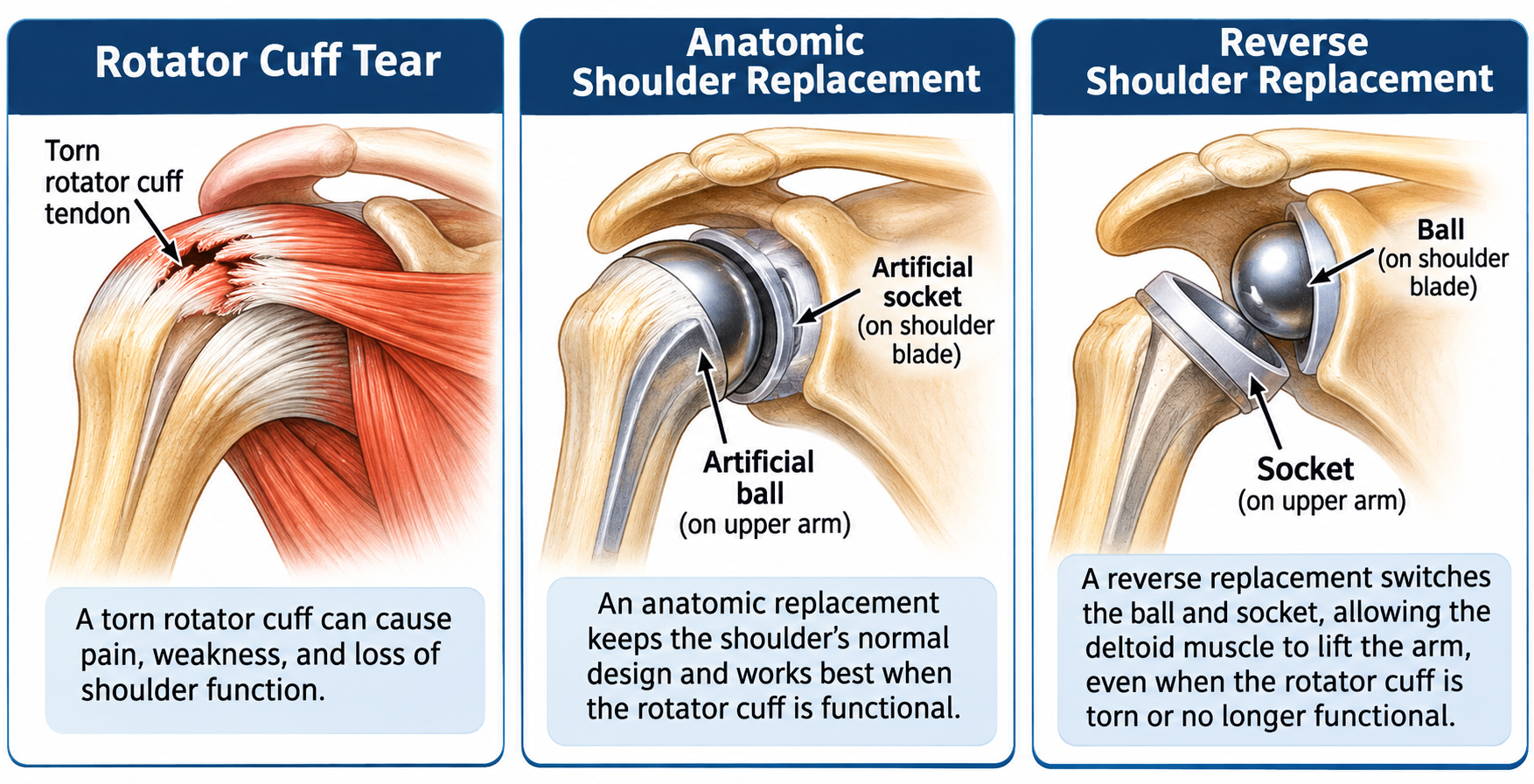
Reverse Shoulder Replacement: Sometimes Backward Is Better
Imagine telling a patient:
“We're going to replace your shoulder, but we're going to put the ball where the socket used to be and the socket where the ball used to be.”
Sounds backward, doesn't it?
Well, that's exactly the idea!
But to understand why this works, we first need to understand something about the normal shoulder.
The Rotator Cuff and Deltoid: A Team Effort
Many people assume that the rotator cuff is the muscle group primarily responsible for lifting the arm.
That's not quite correct.
The deltoid is one of the major muscles providing the power to elevate the arm. But it needs the rotator cuff to help it do that job effectively.
Think of the rotator cuff as the stabilizing member of a team.
When the deltoid contracts, it produces a powerful force that can both elevate the arm and pull the humeral head upward.
The rotator cuff helps compress and center the humeral head within the shallow socket, counterbalancing that upward pull.
This coordinated action creates a stable center of rotation, allowing the deltoid to translate its muscular force into useful arm elevation.
In other words:
The deltoid supplies much of the lifting power. The rotator cuff provides the essential dynamic stability that makes that power effective.
When the rotator cuff becomes severely torn or irreparable, that partnership can break down.
The deltoid may remain perfectly strong, but without adequate rotator cuff stabilization, the humeral head can migrate upward rather than rotate effectively within the socket.
Some patients develop profound difficulty actively raising their arms, even though someone else can lift the arm for them.
Orthopedic surgeons call this pseudoparalysis.
A Painless Shoulder Isn't Necessarily a Functional Shoulder
Imagine having shoulder replacement surgery and waking up with a shoulder that eventually becomes relatively painless.
Sounds wonderful, doesn't it?
But now imagine that despite having little or no pain, you still can't raise your arm high enough to reach into a cupboard, comb your hair, or hit an overhead pickleball shot.
You've relieved the pain, but you haven't restored the function.
And that's a major concern when considering an anatomic shoulder replacement in someone with a severely damaged or inadequate rotator cuff.
An anatomic shoulder replacement reproduces the normal ball-and-socket arrangement. But it still depends on a functioning rotator cuff to stabilize and center the humeral head while the deltoid elevates the arm.
If the rotator cuff is severely deficient, the artificial humeral head may migrate upward, the shoulder may lose its normal mechanics, and the patient may have difficulty actively elevating the arm. Over time, abnormal loading can also threaten the replacement's durability.
In other words, simply replacing the worn-out joint surfaces doesn't necessarily solve the underlying mechanical problem.
A new ball and socket cannot substitute for a missing rotator cuff.
That's why anatomic shoulder replacement is generally best suited to patients with an adequately functioning rotator cuff.
And that's precisely the problem reverse shoulder replacement was designed to address.
By reversing the ball and socket, the surgeon changes the mechanics of the joint, creating a stable fulcrum that allows the deltoid to elevate the arm without depending on an intact rotator cuff.
The objective is not simply to relieve pain.
It's to relieve pain AND restore useful function.
After all, a painless shoulder is nice.
But a painless shoulder that lets you get back onto the pickleball court?
Now we're talking!
The Ingenious Solution: Reverse the Mechanics
Now comes the remarkable part.
In a reverse shoulder replacement, the surgeon places the artificial ball on the shoulder blade and the artificial socket on the upper arm.
This reversal changes the shoulder's center of rotation and creates a more stable mechanical fulcrum.
It also changes the deltoid's mechanical advantage, allowing the muscle to elevate the arm effectively without relying on an intact rotator cuff.
The reverse replacement doesn't repair the damaged rotator cuff. It changes the mechanics so the deltoid can compensate for its loss of function.
That's the real genius of the operation.
Of course, reverse replacement doesn't restore every aspect of normal shoulder function. Certain rotational movements may remain limited, and the deltoid and its nerve supply must be functional.
But for appropriately selected patients who previously struggled to lift their arms, the improvement can be substantial.
And for pickleball players, being able to raise the arm again is a pretty good first step toward returning to the court.
Sometimes you really do have to go in reverse to move forward!
Rehabilitation: A Different Road Back
Recovery after shoulder replacement isn't one-size-fits-all, and the difference between the two operations shows up quickly in rehab.
After an anatomic replacement, the repaired rotator cuff tendons call the shots. Because those tendons have to heal back to bone, early rehabilitation is deliberately cautious — a sling, protected motion, and a gradual, disciplined return of movement and strength over several months.
After a reverse replacement, the script flips — fittingly. Since the new mechanics don't depend on an intact rotator cuff, early gentle motion is often allowed sooner, and rehabilitation centers on conditioning the deltoid, the muscle that has just been handed the starring role.
In both operations, the destination is the same: a shoulder that handles daily life comfortably and gets you back to the activities you love. For a motivated patient, that list very often includes pickleball — and the reverse replacement has made that goal realistic for patients who once couldn't lift their arm high enough to serve.
— Dr. Pickleball
My Two Cents
Shoulder replacement surgery is one of orthopedics' great success stories, and the reverse design is its most creative chapter. Instead of repairing what the body lost, the operation re-engineers how the shoulder works — proof that sometimes the smartest solution isn't fixing the old system but changing it. If your shoulder can no longer lift your arm and your rotator cuff is beyond repair, don't assume nothing can be done. The right operation, in the right hands, can hand you your independence — and your backhand — back.
This article is for general education and is not a substitute for individual medical advice.