
A Veterans Day Salute: My Father’s Quiet Service
By Mark C. Engasser, MD
On Veterans Day, we remember the men and women who answered our country’s call to serve.
Some served on battlefields. Some flew aircraft, cared for the wounded, maintained equipment, or delivered supplies. Others carried out assignments far from the headlines, doing work that helped the people around them do theirs.
This Veterans Day, I would like to remember one of those veterans: my father, Charles Edwin Engasser.
Dad served in the U.S. Army Air Forces during World War II. He was a member of the 10th Weather Squadron, serving in the China–Burma–India region. He entered the service in 1943 and was discharged as a sergeant in 1946.
Before the war, he graduated from Colgate University, where he studied geology. During his military service, his attention turned to the skies.
I Was a Weatherman
In November 1984, I sat down with Dad and asked him questions about his life, our family, and his years in the service. I am grateful now that we had that conversation.
When I asked where he had been stationed, he answered:
“I was in India and China and Burma.”
Then I asked what he did in the service.
“I was in the 10th Weather Squadron. I was a weatherman, weather forecaster.”
I asked whether he had been in combat. He said he had not.
His answers were brief and matter-of-fact. That was Dad’s way. But as I have learned more about the work of his squadron and the conditions in that part of the world, I have come to appreciate the importance of what he and others like him did.
Weather, Mountains, and “the Hump”
During World War II, the Army Air Forces faced an enormous challenge in transporting supplies from India to China. One of the principal air routes crossed mountainous terrain at the eastern end of the Himalayas. Pilots and crews knew it as “the Hump.”
The journey could be dangerous. Aircraft encountered storms, turbulence, mountains, and rapidly changing weather. In an era without the forecasting tools and satellite images we take for granted today, weather observations and forecasts helped crews and commanders make informed decisions.
The 10th Weather Squadron was among the organizations supporting aviation operations in the region. Its personnel gathered and interpreted weather information in a theater where knowing what lay ahead could matter greatly to those in the air.
I do not know every place Dad worked or every forecast he helped prepare. I cannot say that he supported any particular flight. But I do know that he was part of a much larger effort, and I am proud of the role he played.
A Photograph—and Questions I Still Have
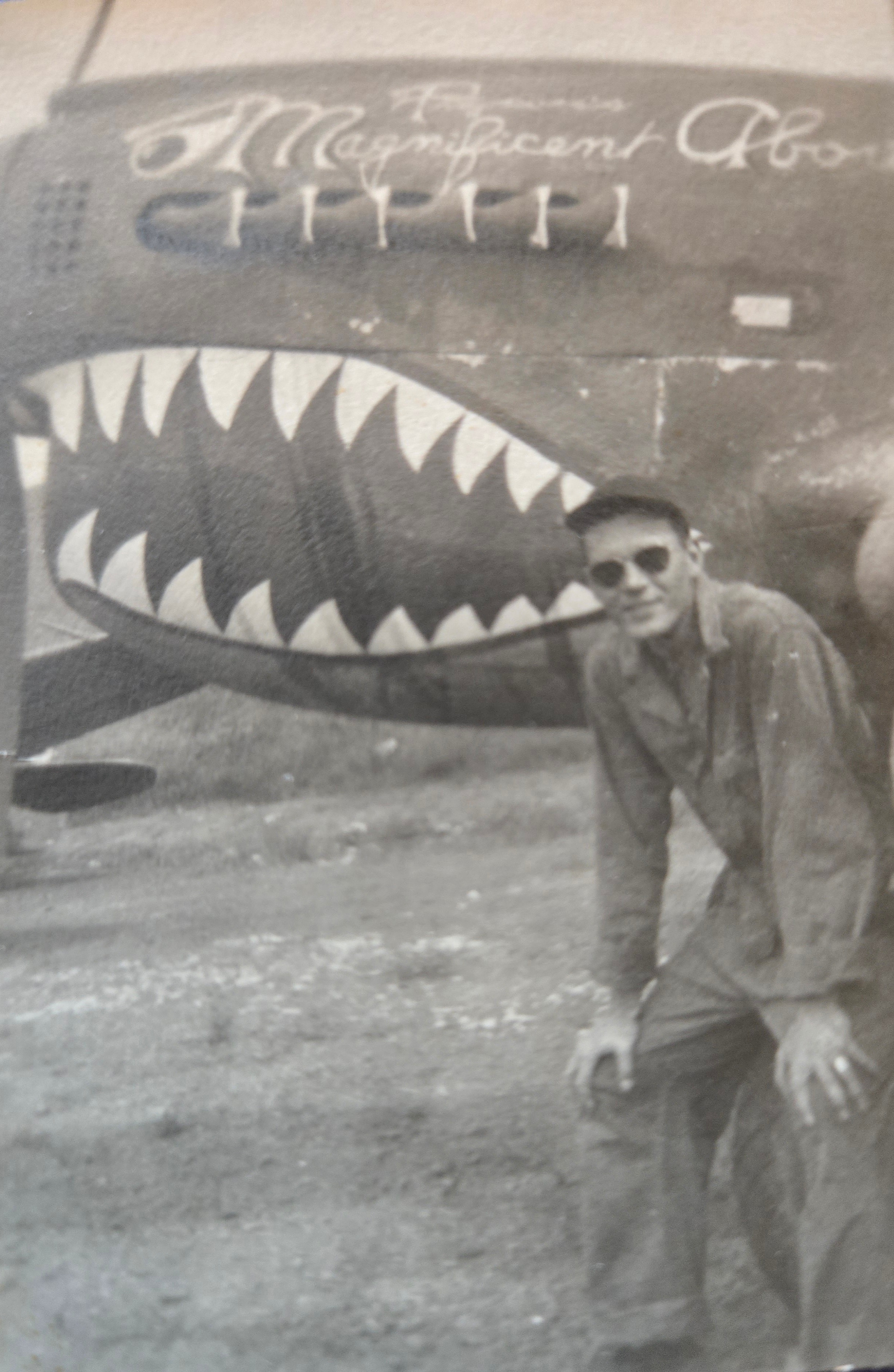
One photograph I treasure shows Dad wearing sunglasses and leaning toward the camera beside an aircraft with a fierce shark’s mouth painted on its nose.
It is a striking picture. The aircraft looks ready for battle; Dad looks as though he has paused for a moment to let someone take his photograph.
I do not yet know exactly where or when it was taken, or the full story of the plane behind him. Perhaps other photographs or records will help answer those questions.
For now, the picture gives me a glimpse of a young man in a place far from home, during a chapter of his life that I am still trying to understand.
A Part of His Life He Rarely Discussed
My father did not talk much about his time in the war, and he had no desire to return to Asia or the Far East. Although he answered some of my questions in 1984, much of what he experienced remained his own.
One image he remembered was a street vendor selling rats for food. It was a sight far removed from the life he had known in Buffalo and one that stayed in his memory.
I cannot say exactly how his experiences affected him or why he chose not to return. The countries he visited have changed enormously in the decades since World War II. Still, his memories were his own, formed at a particular time and under circumstances that are difficult for those of us who were not there to fully understand.
Looking at his photograph today, I find myself wishing I had asked him more. But I am grateful for what he did share.
Coming Home
After the war, Dad returned to the Buffalo area and joined his father in the family building business. Together, they built homes during the years when many American families were beginning new chapters of their own.
In our interview, Dad recalled learning the business by trying to do a little bit of everything. When I asked him what made a person successful in business, his advice was straightforward: offer something people want, make it affordable, and treat people fairly.
That sounds like the father I remember.
Humility, Hard Work, and Letting Your Actions Speak
When I think about my father and the generation that lived through the Depression and World War II, I think about humility and hard work.
They were individuals, of course, and their generation was not perfect. But many understood that success was built over time: show up, do your job, keep your word, and treat people fairly.
Dad did not spend much time talking about what he had accomplished. He came home, went to work, and helped build homes for families beginning lives of their own. He took pride in giving people an honest deal.
Today, we seem surrounded by stories of quick riches, shortcuts to success, and people eager to announce how extraordinary they are. Sometimes it feels as though making money has become more important than making something useful—or that announcing an accomplishment matters more than the accomplishment itself.
Even in sports, an ordinary play can be followed by a celebration elaborate enough to suggest that someone has just won the championship.
That brings to mind Barry Sanders, the remarkable Detroit Lions running back. After making a play that left defenders grasping at air, he was known for returning to the game without a grand display. His style reflected a familiar piece of advice:
“Act like you’ve been there before.”
Sanders walked away from football in 1999 while he was still one of the game’s great players and close to a major rushing record. Whatever went into his decision, he showed that he was willing to leave without chasing one more record.
There is nothing wrong with celebrating an achievement. But there is something admirable about confidence without boasting, success without showing off, and doing a job well without needing everyone to applaud.
Those are qualities I remember in my father. And they are qualities worth passing on.
The Stories We Almost Lose
For many families, piecing together a veteran’s service can be difficult. In 1973, a fire at the National Personnel Records Center in St. Louis damaged or destroyed millions of military personnel files.
I do not yet know the full status of Dad’s military file, but our family has other pieces of his story: the interview, photographs, and information from his service records. Each helps fill in a little more of the picture.
The search has reminded me that family history often survives in places we might overlook—in a photograph tucked away in a box, a discharge paper, a set of dog tags, or a conversation recorded decades ago.
Walking Among the Graves at Normandy
I have visited Normandy American Cemetery in France. Walking among the long rows of white marble crosses and Stars of David, overlooking Omaha Beach, is an experience I believe every American who has the opportunity should have.
The markers bear the names of Americans who came from different states, families, faiths, and backgrounds. Some were born here; others came to America from elsewhere. Each had a life and a story beyond what can be carved into stone.
The markers generally give a name, unit, state, and date of death, but not a date of birth. Without that date, it is easy to walk past without realizing just how young many of those buried there were. Some young Americans even misrepresented their ages to enter the service.
However they came to serve, the lives cut short at Normandy deserve to be remembered as the lives of individuals, not simply as part of a staggering number.
Standing there, it is difficult not to think about the families who waited at home—and about the futures those young men and women never had the chance to live.
Remembering Those Too Often Overlooked
The story of American service belongs to people of many races, faiths, backgrounds, and origins. Some served a nation that had not yet afforded them the full equality or recognition they deserved.
Among them were the African American soldiers of the 320th Barrage Balloon Battalion, who landed at Omaha and Utah Beaches on D-Day. Their mission included helping protect the landing forces from low-flying enemy aircraft.
In the Pacific, Navajo Code Talkers used a code based on their language to transmit military messages. Other Native American service members also used their languages in wartime communications.
We should also remember the Japanese Americans who served during World War II while the United States government forcibly removed and incarcerated many people of Japanese ancestry, including American citizens.
Among those who served were the soldiers of the 100th Infantry Battalion and 442nd Regimental Combat Team, predominantly Japanese American units that fought with extraordinary distinction in Europe. Their service included helping rescue a trapped American battalion in France.
Japanese Americans also served in the Military Intelligence Service, using their language skills in the war against Japan. Their work included translating documents, interpreting, and gathering intelligence.
Their story asks us to hold two truths together: these Americans served their country with courage and loyalty, and their country denied many of them and their families their liberty because of their ancestry.
Their contributions—and those of countless others whose stories received too little attention for too long—are part of the history that made America what it is today.
When we remember our veterans, we should remember all of them.
Remembering What Was at Stake
Veterans Day is also a good time to ask ourselves whether we understand the history that made our freedoms possible.
Young people have every right to question America, criticize its shortcomings, and call for a better country. Those freedoms are among the things generations of Americans have worked and sacrificed to protect.
But those rights come with an opportunity—and, I believe, a responsibility—to learn our history. Before taking our freedoms for granted, we would do well to look at the world my father’s generation faced: the rise of fascism, totalitarian rule, persecution, and a world war that cost millions of lives.
America has never been perfect, and our history includes painful chapters that deserve honest attention. But the freedoms we enjoy did not appear on their own, and they have not preserved themselves. They have been defended by people in uniform and sustained by citizens willing to participate in our democracy.
I hope younger Americans will listen to veterans and their families, learn what was at stake, and appreciate the sacrifices that helped preserve their ability to speak freely—even when what they have to say is critical of their country.
Knowing that history can deepen our gratitude and strengthen our determination to make America better.
Thank You
This Veterans Day, I am grateful for the opportunity to remember my father—not only as a veteran, but as the man I knew as Dad.
I also want to recognize all veterans, wherever and however they served. Every assignment was part of a larger mission, and every veteran came home with experiences that belonged to them, whether they chose to speak about them or not.
To all who served: thank you.
And if a veteran’s story is part of your family, consider taking the time to ask about it, write down what you learn, and preserve the photographs and papers that remain. Sometimes the simplest questions can keep a story alive for generations.
This article is for general education and is not a substitute for individual medical advice.