
Carpal Tunnel Syndrome
"When Your Fingers Go to Sleep Before You Do!"
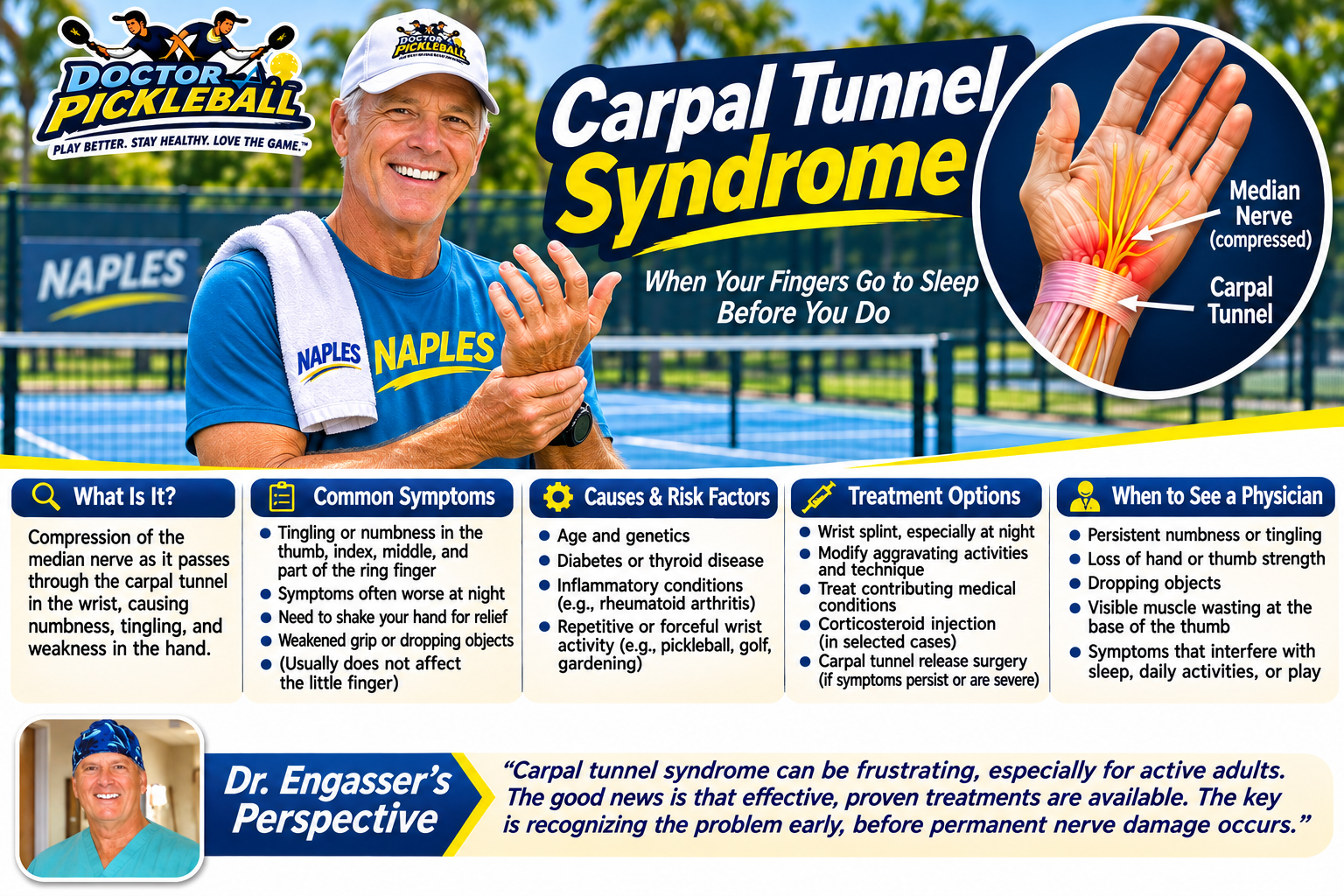
Ever wake up at 3 a.m. with your fingers tingling, your hand numb, and the uncomfortable feeling that someone has been sleeping on your arm?
You shake your hand, wiggle your fingers, and eventually things improve. Then you go back to sleep — until your hand decides it's time for another wake-up call.
Welcome to the world of carpal tunnel syndrome.
What's going on?
Carpal tunnel syndrome occurs when the median nerve becomes compressed as it travels through a narrow passageway in your wrist called the carpal tunnel.
The median nerve supplies sensation to your thumb, index finger, middle finger, and part of your ring finger. It also helps control certain thumb muscles.
When pressure increases around the nerve, you may experience numbness, tingling, discomfort, and sometimes weakness.
Your little finger is usually spared. That's an important clue!
How do you recognize it?
Common symptoms include:
- Numbness or tingling in the thumb, index, and middle fingers.
- Symptoms that wake you up at night.
- Tingling while driving, reading, or holding a phone.
- Shaking your hand to relieve the discomfort.
- Difficulty with fine motor tasks or dropping objects.
Symptoms may initially come and go. More advanced cases can produce persistent numbness and weakness of the thumb muscles.
Not every numb hand has carpal tunnel syndrome. Problems involving the neck, other peripheral nerves, or generalized neuropathy can cause similar symptoms.
What actually works?
A neutral-position wrist brace can reduce symptoms, particularly when the condition is mild or moderate.
Avoiding prolonged wrist flexion or extension and modifying activities that aggravate symptoms may help.
An injection into the carpal tunnel can provide temporary relief for some patients, although symptoms may return.
Carpal tunnel release reduces pressure on the median nerve by dividing the transverse carpal ligament. It can be highly effective, particularly when symptoms are persistent or nerve dysfunction is progressing.
Treatment depends on symptom severity, duration, examination findings, and sometimes electrodiagnostic testing.
What about pickleball?
Holding a paddle doesn't automatically mean you're going to develop carpal tunnel syndrome.
However, forceful gripping, prolonged wrist positioning, or repetitive activities may aggravate symptoms in someone who already has the condition.
Try relaxing your grip between shots and avoiding unnecessary wrist tension.
Remember, your paddle isn't trying to escape!
When should you see a doctor?
Seek evaluation if you have persistent numbness, progressive weakness, loss of thumb muscle bulk, or symptoms interfering with sleep and daily activities.
Early assessment is especially important when weakness or constant sensory loss develops, because prolonged nerve compression can result in lasting dysfunction.
Learn More: A Closer Look at Carpal Tunnel Syndrome
Diagnosis, risk factors, surgery, recovery, and further reading
How is carpal tunnel syndrome diagnosed?
Diagnosis usually begins with the history and physical examination, including the distribution of numbness, thumb muscle strength, and provocative maneuvers.
Nerve conduction studies and electromyography may be useful when the diagnosis is uncertain, symptoms are atypical, or additional nerve disorders are suspected. They are not required in every straightforward case.
Who is more likely to develop it?
Risk factors and associated conditions include diabetes, rheumatoid arthritis, pregnancy, obesity, and certain occupational or repetitive hand exposures.
When is surgery considered?
Surgical release may be recommended for persistent symptoms despite appropriate nonsurgical treatment, severe nerve compression, progressive weakness, or muscle atrophy.
The procedure can be performed using open or endoscopic techniques. Both aim to relieve pressure on the median nerve.
What should you expect after treatment?
Nighttime tingling often improves relatively quickly after successful decompression. Recovery of sensation or strength can take longer, particularly when nerve compression has been severe or longstanding.
Advanced nerve damage may not fully reverse.
Further Reading
- American Academy of Orthopaedic Surgeons (AAOS): Carpal Tunnel Syndrome — OrthoInfo
- American Academy of Orthopaedic Surgeons: Management of Carpal Tunnel Syndrome Clinical Practice Guideline
- National Institute of Neurological Disorders and Stroke: Carpal Tunnel Syndrome
Medical education only. This article is not a substitute for individualized medical evaluation, diagnosis, or treatment.
My Two Cents
Practical Pearls from Dr. Engasser.
Before you jump into treatment, here are a few things I've learned over the years that may help you ask better questions and make better decisions.
One of the most recognizable complaints I hear about carpal tunnel syndrome is waking up at night with numb, tingling fingers.
Patients sometimes assume the problem must be coming from their neck or shoulder. The pattern of affected fingers, the examination, and appropriate testing help me sort out the possible causes.
And here is the point I would most want you to remember: do not ignore progressive numbness or weakness simply because the symptoms temporarily improve when you shake your hand.
Pearl No. 1
If you have symptoms of numbness and tingling, an easy thing to do would be to get a simple wrist brace that keeps your wrist straight from Amazon. It does not have to include the thumb, but it might be effective in improving your symptoms if you just wear it at night.
Pearl No. 2
For a number of years, I have had EMGs that would show that I have carpal tunnel syndrome, yet I have never had severe symptoms that would bother me in any way. Just make sure that you have the clinical symptoms before you consider treatment. There's really no harm in waiting as long as your symptoms are not becoming worse or are affecting your life.
Pearl No. 3
The more your symptoms are involving the thumb, index, middle, and part of the ring finger, the less chance the problem is related to the neck or a pinched nerve in another area, and the more it is likely to be carpal tunnel syndrome. So don't be fooled by having numbness in these areas and thinking it is from the neck.
Medical education only. This article is not a substitute for individualized medical evaluation, diagnosis, or treatment.